
Understanding AC/DC Power Adapters
What Is a Power Adapter?
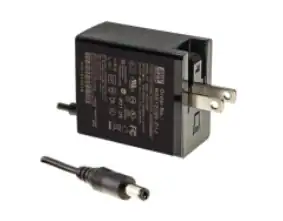
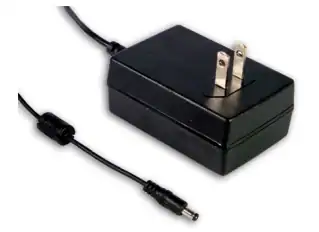
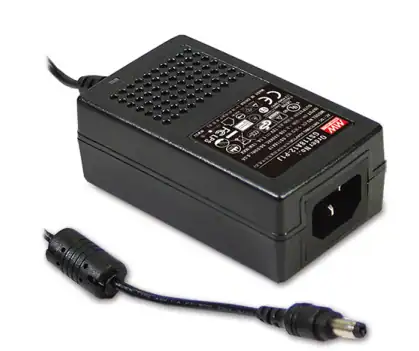
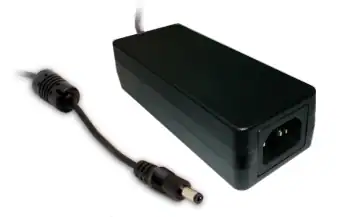
In the industry, the term “adapter” has become a commonly used term referring to the familiar AC/DC power brick shown above.
Understanding the Specifications
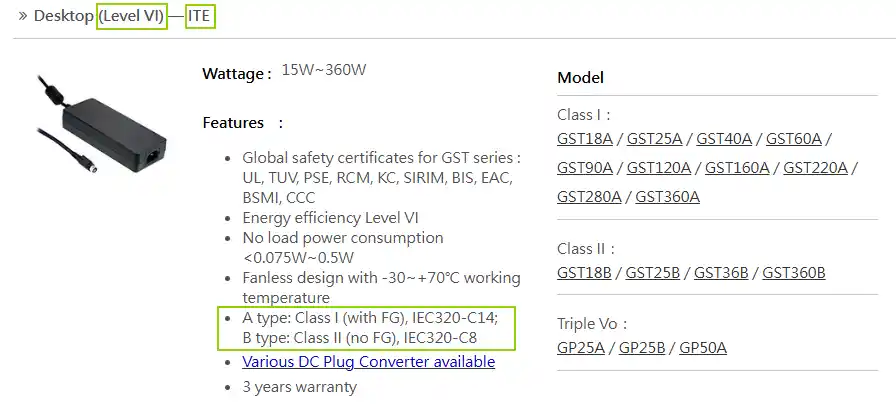
The Mean Well GST series is a typical AC/DC power adapter.
To understand this type of datasheet, you only need to focus on the following four key points.
01 Level VI
Energy Efficiency Level VI
This is the power adapter’s energy efficiency rating.
For audio systems, it is not one of the most important specifications.
02 ITE (IT Equipment)
Information Technology Equipment
For general information technology equipment
Designed for general-purpose applications.
For normal use, this is usually the right choice.
03 Class I / Class II
with FG / without FG
The main difference is whether FG is provided.
From the outside, this is usually reflected by whether the AC input uses a 2-pin or 3-pin connection.
If FG is present, you also need to check what it is connected to. FG is a more complex concept, so we will explain it in more detail below.
04 What Is FG?
Frame Ground / Chassis Ground
Chassis ground / grounding terminal
Chassis ground refers to the equipment’s own chassis. Even a power adapter with a plastic enclosure may still have FG, in which case FG refers to the internal chassis, shielding, or grounding structure.
This is a very important concept and needs to be clearly understood. We will explain it in more detail below.
Another important concept will also appear: PE.
Once you understand both FG and PE, you have a solid foundation for understanding “ground” in electrical systems.
Less common option
05 Triple Vo
Triple output
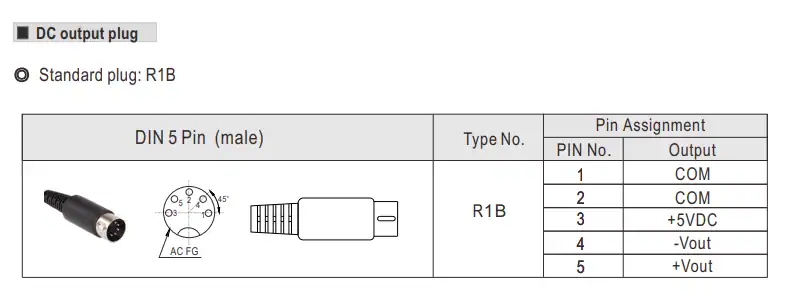
Mean Well uses a 5-pin DIN male connector to provide three output voltages.
The pinout is shown below:
Medical-Grade Power Adapters
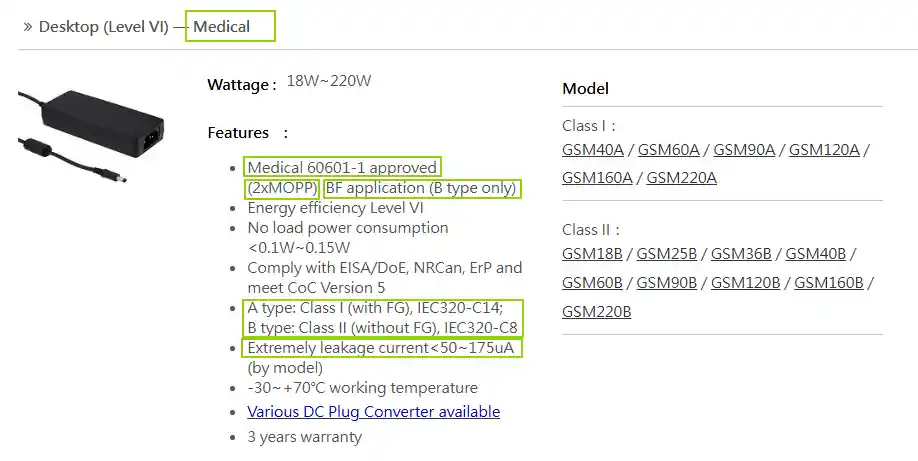
The Mean Well GSM series is a typical “medical-grade” AC/DC power adapter.
Compared with standard adapters, this type adds five key points to consider.
01 Medical
Medical-grade / For medical use
Certified to meet medical safety standards.
02 MOPP / 2 MOPP
One Means of Patient Protection / Two Means of Patient Protection
These are concepts defined in the medical electrical equipment safety standard IEC 60601-1, covering multiple safety requirements.
One important requirement is higher dielectric isolation between the primary and secondary sides of the power supply, typically around the 4 kVAC level.
03 BF Application
Body Floating
BF application (B type only)
Limited to B type: Class II, without FG, with a 2-pin AC input.
Body: refers to the patient’s body. Some medical equipment requires adequate electrical isolation between the patient and earth, such as ECG lead systems.
If the isolation is insufficient, fault current may flow through the patient’s body to earth under certain conditions, creating a serious risk of electric shock.
04 Class I / II
with FG / without FG
This is similar to the concept used for ITE equipment: the AC input may be 2-pin or 3-pin, meaning without or with a grounding pin.
05 Leakage Current
Leakage current
Here, leakage current refers to the current flowing between the high-voltage side and the low-voltage side, or between the high-voltage side and FG.
Leakage current usually refers to AC leakage current. The actual value and test conditions should be confirmed in the detailed technical documentation.
For DC isolation, a high insulation resistance is typically required, with 100 MΩ being a common specification.
Electrical Relationship Between the Output and FG: Floating or Shorted?
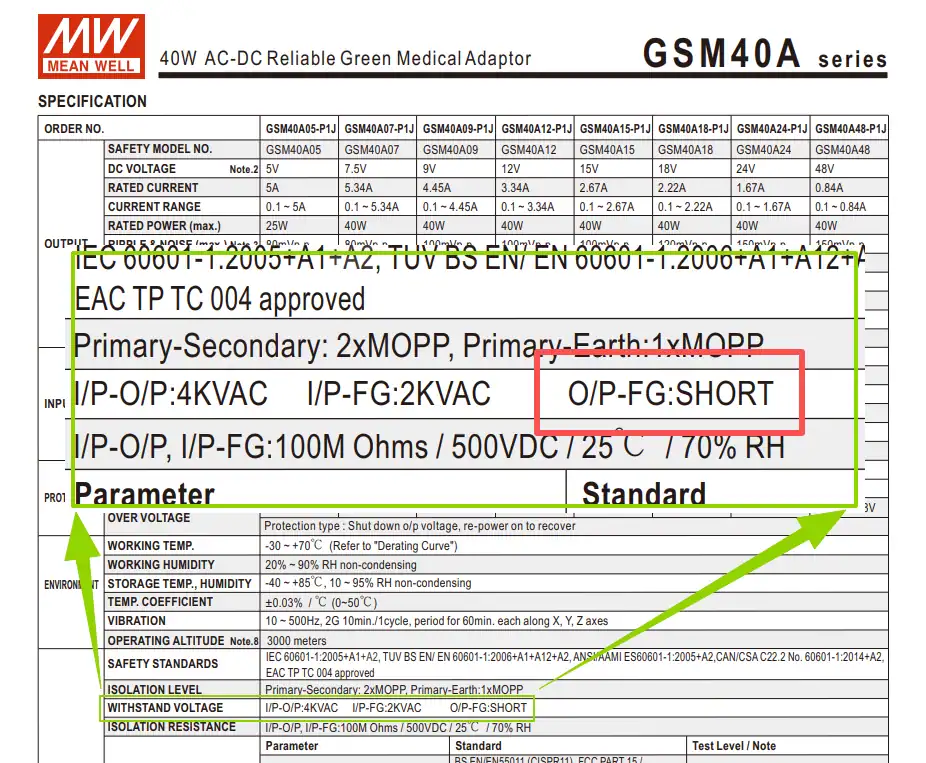
In the datasheet for Mean Well’s medical-grade Class I GSM40A, it is clearly specified:
O/P–FG: SHORT
This means:
The output terminal (typically the DC negative output) is directly connected to FG.
FG is then connected through the third grounding pin of the AC input to the mains PE (Protective Earth) system.
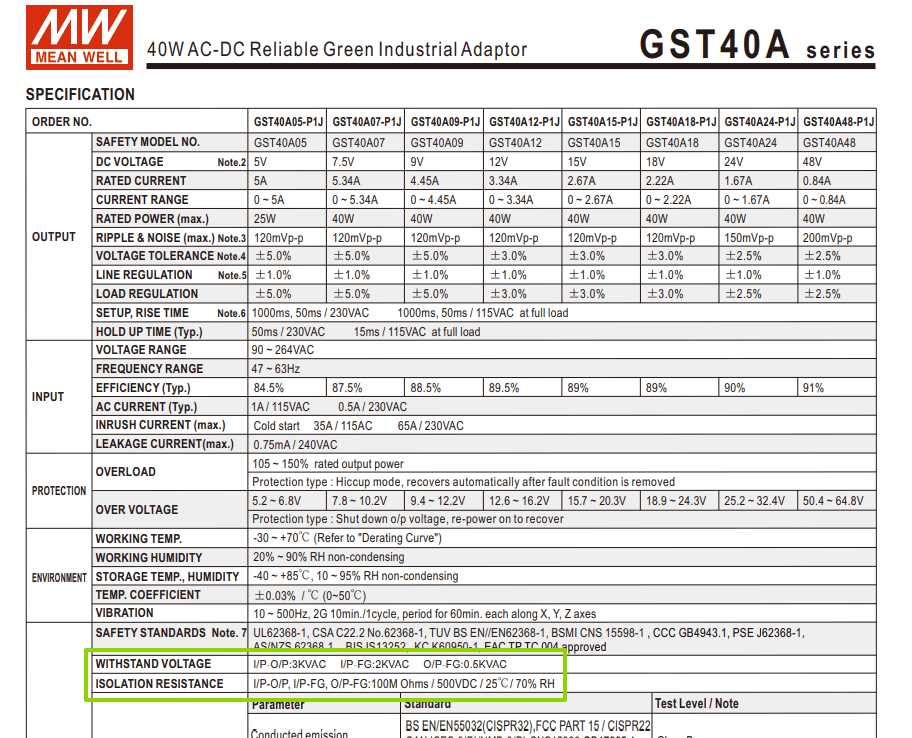

In the datasheet for Mean Well’s general-purpose (ITE) Class I GST40A, it is clearly specified:
O/P–FG: 0.5 kVAC
I/P–O/P, I/P–FG, O/P–FG: 100 MΩ
This means:
The input, output, and FG are electrically isolated from one another, with no direct short connection between them. The output therefore remains floating relative to FG.
The difference is clear:
ITE-grade GST40A: the output is floating.
Medical-grade GSM40A: the output is directly shorted to FG.
First, let’s clarify a few important concepts: FG, PE, and the three conductors in the AC mains supply.
In a mains plug or outlet, there are three conductors:
L / Line / Live
Live conductor; also referred to as the ungrounded conductor
N / Neutral
Neutral conductor; also referred to as the grounded conductor
PE / Protective Earth / Ground
Ground / Protective Earth / protective grounding conductor
FG: Frame Ground / Chassis Ground
Safety regulations require that, in Class I equipment with a 3-pin power plug, accessible conductive metal parts be reliably connected to the grounding pin of the power plug. Once connected to the mains supply, this grounding pin is in turn connected to the PE (Protective Earth) system.
Some Mean Well adapters use a fully plastic enclosure, so FG in the datasheet should not always be interpreted literally as “metal chassis ground.”
In such designs, FG is better understood as an internal grounding node that may be used for EMI control, common-mode noise, Y-capacitor return paths, shielding, or filtering. Whether it functions as Frame Ground, Functional Ground, or is directly tied to PE depends on the specific product and should be confirmed from the datasheet and grounding architecture.
So:
FG is the grounding point on the equipment side, while PE is the overall protective earthing system. If the equipment’s FG is used for protective grounding, it is connected through the third pin of the power plug to the PE contact of the outlet.
The third pin of the plug and the third contact of the outlet are both part of the PE protective grounding path.
FG is the name used on the equipment side—in this article, the power adapter—for this grounding node.
One important exception is:
FG does not always mean PE.
If FG refers to Functional Ground / Functional Earth, it may be used only for EMI control, noise reduction, shielding, or filtering, and should not automatically be treated as Protective Earth.
A few useful facts:
In Taiwan, the neutral conductor of a 110 VAC supply is grounded at the designated system grounding point.
Taiwanese homes also commonly have 220 VAC circuits for higher-power appliances such as air conditioners and electric water heaters. A typical residential 110/220 V system uses two 110 V line conductors that are 180° out of phase:
L1–N ≈ 110 V
L2–N ≈ 110 V
L1–L2 ≈ 220 V
Therefore, each of the two 220 V line conductors is typically about 110 V with respect to ground.
Taiwanese electrical regulations require that N and PE remain separate at normal branch circuits and outlets. N carries normal operating current, while PE is a safety conductor. They serve different functions, although they may be bonded together at the designated system grounding point.
In real-world building wiring, however, older installations, modifications, or non-compliant wiring may exist. Therefore, the actual relationship between N and PE should not be judged solely from the appearance of the outlet.
For general applications—especially in audio systems—it is usually preferable to keep the output floating rather than directly shorting it to FG.
The output should remain floating.
Imagine your iPhone while charging: if its chassis were directly shorted to the third contact (PE) of the mains outlet, would you consider that an ideal design?
Usually not.
For general consumer electronics, it is typically preferable to maintain appropriate electrical isolation between the user-accessible low-voltage side and the mains grounding system, rather than directly tying them together.
Therefore, for a typical isolated AC/DC power adapter, keeping the output floating is generally the more universal approach and helps avoid unintended ground-current paths.
What Problems Can Occur If the DC Output Is Shorted to FG?
01 PE is Protective Earth, not a “clean ground” for audio systems.
The primary function of mains PE (Protective Earth) is safety protection, not to provide a low-noise reference for audio circuitry.
In real systems, PE conductors have both resistance and inductance and are shared by many devices within a building. Switching power supplies, EMI filters, and other loads can inject common-mode noise into PE through parasitic capacitance or Y capacitors. As a result, PE may carry mains-frequency potential differences, high-frequency switching noise, and transient interference.
Therefore, in audio system design:
PE ≠ Signal Ground ≠ Audio 0V
02 Shorting FG to O/P may create an unintended high-current return path
FG and the power supply output (O/P) are normally separate functional nodes. Directly shorting FG to O/P can alter the original isolation and grounding arrangement and create an unintended return-current path.
If the system is also connected to PE, other equipment grounds, or signal ground, this path may carry significant circulating current and, in severe cases, may even behave like a fault-current path approaching a short circuit.
Conclusion:
In ITE (general-purpose) adapters, O/P and FG are typically floating relative to each other.
In Medical-grade adapters, O/P and FG may be directly shorted.
For the reasons discussed above, do not choose a medical-grade adapter for an audio system simply because it is labeled “medical-grade.”
Does Medical Grade Always Mean O/P–FG: SHORT (Output Shorted to FG)?
Not necessarily.
A medical-grade adapter with a 3-pin AC input may use:
O/P–FG: SHORT (the output is directly shorted to FG)
The actual configuration must be confirmed in the manufacturer’s datasheet.
If you are not comfortable reading or interpreting professional datasheets, it is best to avoid replacing or selecting a medical-grade adapter on your own.
Medical Grade = Better Sound Quality?
Not necessarily.
Mean Well — ITE Adapter GST40A →
Mean Well — Medical Adapter GSM40A →
Using Mean Well’s GST and GSM series as examples, GST is designed for general ITE / industrial applications, while GSM is a medical-grade adapter. GSM complies with IEC 60601-1 medical safety requirements, provides 2×MOPP isolation, and offers lower leakage current. Some models are also suitable for BF applications.
When comparing the 24 V / 40 W versions, GSM and GST have the same specifications for output ripple and noise, voltage regulation, load regulation, and efficiency. The most obvious difference is that the medical-grade GSM has much lower leakage current: the GSM40A specifies Earth Leakage / Touch Current below 100 µA, while the GST40A allows up to 0.75 mA leakage current.
Therefore, the real advantages of a medical-grade adapter are:
Higher isolation safety, lower leakage current, and stricter requirements for patient and human-contact safety.
For audio systems, these characteristics may sometimes result in lower common-mode leakage and a more controllable grounding environment. However, “medical-grade” does not automatically mean “better sound quality.”
Conclusion: Should You Use a Medical-Grade Adapter in an Audio System?
The main advantages of a medical-grade adapter are higher isolation ratings, lower leakage current, and stricter safety requirements. This does not necessarily mean that it offers lower ripple, lower noise, or better sound quality than a standard adapter.
Do not upgrade simply because an adapter is labeled “medical-grade.” If you do not fully understand the relationships among O/P, FG, PE, and Audio Ground, as well as power-supply isolation, grounding architecture, and system interconnections, using the manufacturer-recommended or properly specified standard adapter is usually the more appropriate choice.